Ghana’s development story has often been defined by bold ideas. The challenge, historically, has not been vision, but execution.
What is emerging under the 24-Hour Economy and Accelerated Export Development Programme is an attempt to close that gap deliberately. And the recent Memorandum of Understanding (MOU) signed between the 24-Hour Economy Secretariat and Hunan Architectural Design Institute Group signals something important: a shift from ambition to structure.
At the heart of this partnership is a simple but critical insight, large-scale transformation does not begin with construction. It begins with planning.
For decades, countries that have successfully industrialised have followed a disciplined sequence: define the land, design the systems, build the infrastructure, and then attract production. Ghana is now applying that same logic to the Volta Economic Corridor, its flagship integrated development zone stretching from Tema to Tamale.
This corridor is not just a geographic stretch. It is an economic system in design.
It brings together agroecological parks, industrial zones, energy infrastructure, and transport networks into a single, coordinated production ecosystem. The goal is clear: reduce dependence on imports, scale domestic production, and position Ghana as a competitive exporter.
But systems of this scale demand precision.
They require detailed spatial planning, land use demarcation, infrastructure mapping, water and sanitation systems, transport linkages, and energy integration. Without this, industrial parks remain concepts, investors hesitate, and communities see little impact.
This is where the partnership with Hunan Architectural Design Institute becomes strategically significant.
Hunan’s own transformation offers a relevant precedent. Once known primarily as an agricultural region, it evolved over three decades into a major industrial and engineering hub. That shift was not accidental. It was driven by deliberate planning through corridors, zones, and infrastructure systems designed ahead of industrial expansion.
By bringing this experience into Ghana’s planning process, the partnership introduces technical depth into a national ambition.
But beyond technical capability, the collaboration also reflects something less visible, yet equally important: alignment of intent.
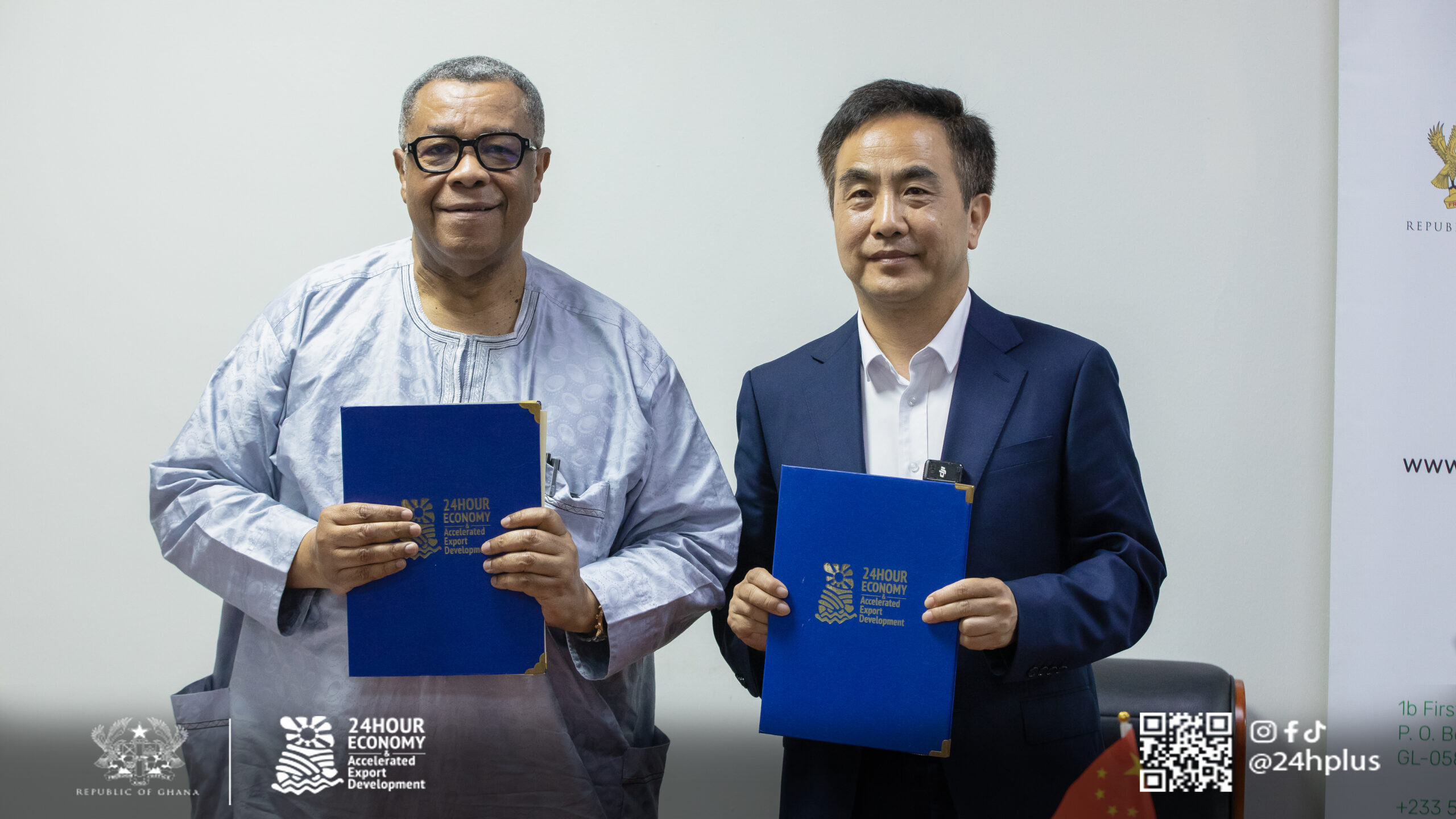
At the signing ceremony, Chairman He Liu of Hunan Architectural Design Institute expressed strong confidence in Ghana’s development direction, emphasizing that the partnership is anchored in a practical and forward-looking vision. He reaffirmed his organisation’s readiness to support Ghana’s development and noted that the clarity of vision and intent provides assurance that the collaboration rests on a solid and credible foundation.
For a firm that already maintains partnerships within that ecosystem, the signal was clear: Ghana is positioning itself not just as a participant, but as a connector within global development networks.
This matters.
Because infrastructure today is no longer just about roads and buildings. It is about how countries position themselves within supply chains, logistics systems, and investment flows. The ability to integrate planning, financing, and execution determines competitiveness.
The MOU also reflects a shift in how such infrastructure will be delivered.
By incorporating models such as EPC+F (Engineering, Procurement, Construction + Financing) and EPC+I (Engineering, Procurement, Construction + Investment), the partnership recognises that public budgets alone cannot finance transformation at this scale. Instead, the focus is on structuring projects to attract private capital, an approach that aligns with global best practice.
Importantly, the collaboration is not starting at scale. It begins with defined pilot projects; two industrial parks and three agroecological parks. This phased approach allows for testing, learning, and refinement before expansion across the full corridor.
It is a measured strategy. And in development, that discipline often determines success.
The projected outcomes are significant. The Volta Economic Corridor alone is expected to generate over 500,000 direct jobs while strengthening Ghana’s production and export capacity. But beyond the numbers, the deeper impact lies in the shift it represents from fragmented development efforts to integrated economic design.
There is also a deliberate focus on capacity building.
The partnership includes technical exchange, ensuring that Ghanaian planners and engineers are not just recipients of expertise but active participants in the process. This is essential. Sustainable development requires not only infrastructure, but institutional capability.
Taken together, the agreement signals a broader evolution in Ghana’s development approach, one that prioritises planning, embraces partnerships, and structures opportunities for investment and growth.
It is still early. The real test will be in execution, how quickly plans translate into designs, designs into construction, and construction into functioning economic systems.
But if the foundation is any indication, the direction is clear.
Ghana is not just building projects. It is building systems.
And partnerships like this one suggest that, this time, the structure may finally match the vision.