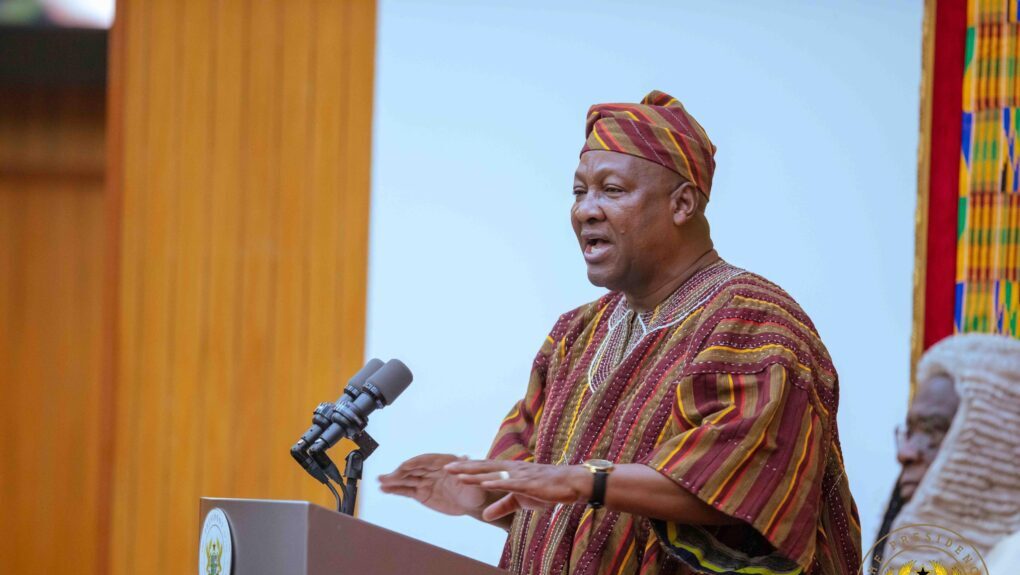
On 27 February 2026, President John Dramani Mahama delivered his 2026 State of the Nation Address before the Parliament of Ghana, outlining the progress made over the past year and the policy direction for the year ahead.
The address signalled a government firmly focused on stabilization, structural reform, and accelerated production pillars that directly reinforce Ghana’s 24-Hour Economy and Accelerated Export Development Programme.
From Stabilization to Expansion
In reviewing the past year, the President highlighted improvements in macroeconomic indicators, including easing inflationary pressures, debt restructuring progress, and renewed investor confidence. These developments, he noted, are laying the foundation for the next phase of economic expansion.
However, the 2026 address moved beyond stabilization. It emphasized the transition toward sustained productivity, industrial deepening, and export competitiveness: the very objectives at the heart of the 24-Hour Economy framework.
Anchoring the 24-Hour Economy
A central theme of the address was the operationalization of the 24-Hour Economy and Accelerated Export Development Programme. The President reaffirmed government’s commitment to ensuring that Ghana’s productive sectors; agriculture, manufacturing, construction, logistics, tourism and the creative industries function more efficiently through extended hours and improved coordination.
This model is not about longer working hours alone. It is about:
- Maximizing the use of existing infrastructure
- Reducing idle capacity across value chains
- Strengthening logistics and energy alignment
- Expanding export-oriented production
- Creating sustainable jobs for Ghana’s growing workforce
By improving coordination between ministries, agencies, utilities, financial institutions and private sector actors, the programme aims to convert policy ambition into measurable output.
Energy, Infrastructure and Financing Alignment
The President outlined reforms in the energy sector, including renegotiation of power purchase arrangements and improved sector efficiency. Reliable and affordable energy remains fundamental to sustaining continuous industrial activity.
Infrastructure development and financing reforms were also highlighted as critical enablers of productivity. These align directly with the programme’s Build24 and Fund24 pillars, which prioritize coordinated infrastructure delivery and improved access to capital for businesses operating within the 24-Hour Economy framework.
Agriculture and Export Acceleration
Agricultural transformation received renewed attention, with commitments to food security, buffer stock management and commercialization of the sector. By strengthening agro-processing and linking farmers to structured markets, the government aims to shift agriculture from subsistence activity to industrial-scale production, a necessary condition for export expansion.
The Accelerated Export Development component of the programme complements this strategy by positioning Ghanaian products more competitively in regional and global markets.
Governance, Accountability and Execution
The 2026 SONA also underscored fiscal discipline, public sector efficiency and accountability. These governance measures are essential to ensuring that extended production hours translate into real economic gains rather than inefficiencies.
A 24-Hour Economy requires more than ambition; it requires execution discipline, inter-institutional coordination and measurable outcomes.
A National Operating Model for Growth
The 2026 State of the Nation Address reinforces a clear national shift from episodic growth to continuous productivity, from fragmented initiatives to structured coordination, and from dependence to export-driven expansion.
As Ghana advances into the next phase of implementation, the 24-Hour Economy Secretariat remains committed to translating this national vision into tangible results: higher production, stronger exports, quality job creation, and a competitive economy that works around the clock.