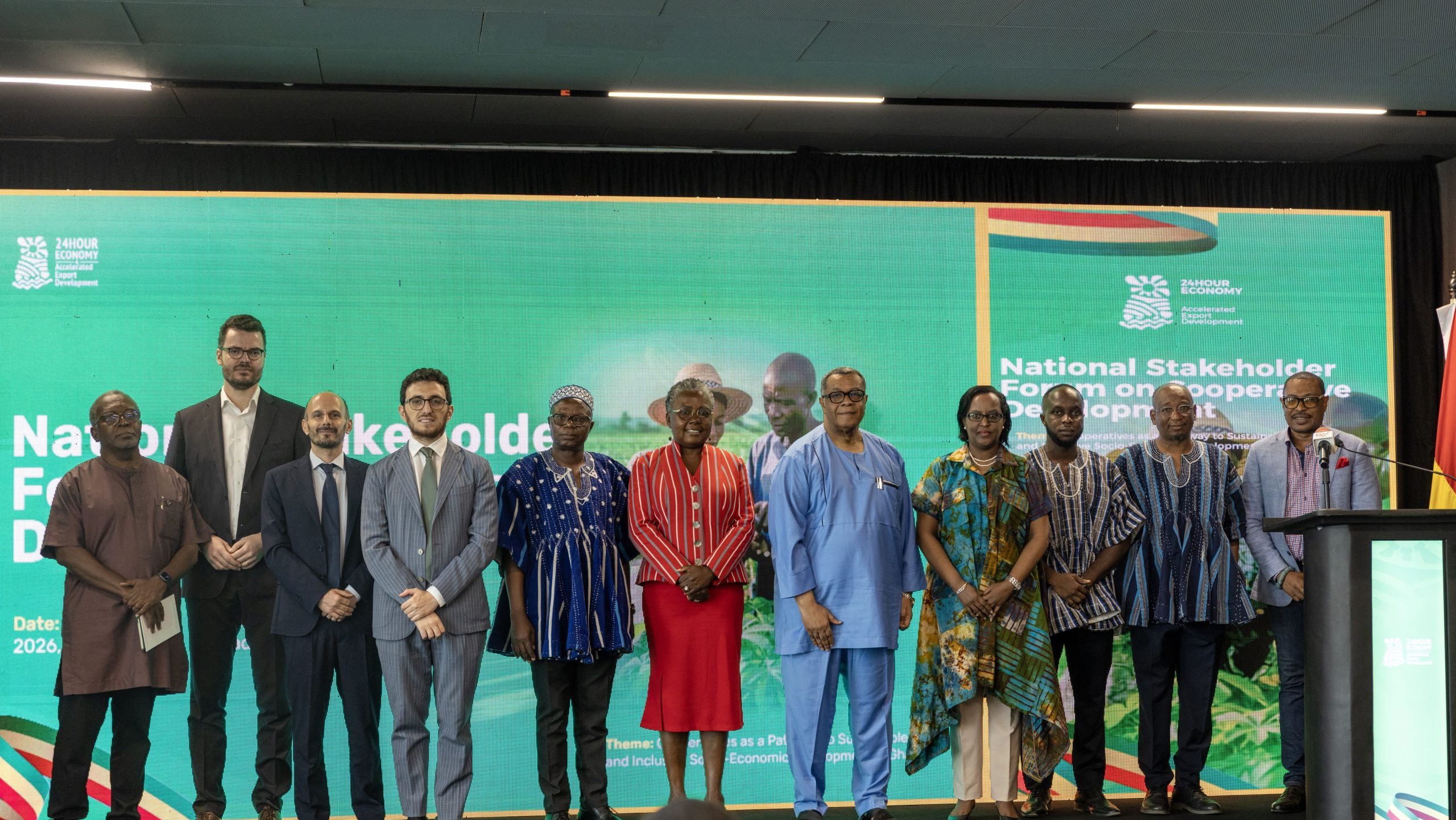
The 24-Hour Economy and Accelerated Export Development Programme Secretariat has convened a National Stakeholder Forum on Cooperative Development, bringing together government, development partners, financial institutions, and cooperative leaders to position cooperatives as drivers of inclusive and sustainable socio-economic development in Ghana.
Held under the theme “Cooperatives as a Pathway to Sustainable and Inclusive Socio-Economic Development in Ghana,” the forum provided a platform for dialogue, consensus-building, and action to strengthen the cooperative sector. The movement currently represents over 2.5 million Ghanaians across agriculture, financial services, transport, fisheries, industry, and trade.
Cooperatives Positioned as Key Drivers of Inclusive Growth
In his opening address, Augustus Goosie Tanoh, Presidential Advisor for Ghana’s 24-Hour Economy and Accelerated Export Development Programme, underscored the critical role of cooperatives in revitalising Ghana’s real sector, including agriculture, manufacturing, and SMEs.
He noted that cooperatives remain one of the most effective vehicles for empowering women, youth, and small businesses, but face longstanding challenges including limited access to finance, weak institutional support, and an outdated legal framework that is now over 58 years old — a decree that predates the majority of people working in the sector today. He stressed that cooperatives that cannot access capital cannot grow, and called on all stakeholders to leave the forum with concrete commitments to change.
Strong Call for Legal and Institutional Reforms
Delivering remarks on behalf of the cooperative movement, Frank Agyekum, Acting Secretary-General of the Ghana Cooperative Council, highlighted the significant contributions of cooperatives to livelihoods, financial inclusion, and local economic development, noting that the Council is the apex body representing cooperative societies across Ghana.
He pointed to concrete examples of what cooperatives can achieve: the Bia West Cooperative Cocoa Farmers and Marketing Union, with over 11,000 members, receives an annual premium of approximately $1 million under the Mondelez Cocoa Life Programme, while the credit union movement manages assets exceeding GHS 8.2 billion, employs over 7,000 people, and mobilises more than GHS 5.8 billion in member deposits.
Despite these achievements, Mr. Agyekum was clear that NLC Decree 252 of 1968 has become the ceiling on the sector’s potential, calling for its urgent repeal and replacement with a modern framework aligned with global best practices, including the frameworks of the International Co-operative Alliance, the International Labour Organization( ILO), and the African Model Cooperative Law. “What cooperatives are asking for is not charity,” he said. “They are asking for the same conditions every successful enterprise requires: a clear legal framework, access to finance, strong governance systems, and institutional support that enables growth.”
Stakeholders broadly agreed that legal and regulatory reform is essential to unlocking investment, strengthening governance, and enabling cooperatives to scale sustainably.
Unlocking Financing, Inclusion and Sector Opportunities
The Minister for Fisheries and Aquaculture Development, Emelia Arthur, highlighted the role of cooperatives in boosting aquaculture, creating jobs, and enhancing value addition for export. She indicated the government’s intention to work with cooperatives across 80 selected districts to strengthen fish production and contribute to food security and economic growth.
The Chief Director of the Ministry of Labour, Jobs and Employment, Hamidu Adakruogu, reaffirmed the Ministry’s commitment to strengthening the regulatory environment, promoting decent work standards, and positioning cooperatives as viable platforms for structured job creation, particularly for the youth.
A presentation by the Bank of Ghana further underscored the importance of deepening financial inclusion and strengthening financial systems to support cooperative growth.
Multi-Stakeholder Dialogue and Practical Solutions
Panel discussions and technical sessions brought together key stakeholders across government, financial institutions, development organisations, and the cooperative sector. Contributions came from institutions including the Department of Cooperatives, Oxfam, Solidaridad, Ghana Microfinance Institutions Network (GHAMFIN), the Venture Capital Trust Fund, and the World Food Programme.
Discussions focused on addressing structural challenges, including:
- Limited access to sustainable financing
- Weak governance and institutional capacity
- Fragmented policy and regulatory frameworks
Participants emphasised the need for coordinated action, including the establishment of technical working groups to drive reforms across key thematic areas. The forum also highlighted the potential of digital tools and technology, including artificial intelligence, to help cooperatives improve governance, clean up membership registries, and attract capital market investment.
A Collective Commitment to Action
The forum concluded with a shared commitment to advancing reforms across four priority areas:
- Legal and regulatory framework
- Capacity development and training
- Financing and funding mechanisms
- Inclusive socio-economic development
These priority areas will guide ongoing collaboration among stakeholders to reposition cooperatives as viable engines of national development. With 25,656 registered cooperatives as of 2022; with 80 percent of them in agriculture, the scale of the opportunity, and the urgency of reform, is clear.
The National Coordinator for the 24-Hour Economy and Accelerated Export Development Programme, Kyeretwie Opoku, expressed appreciation to all stakeholders and participants for their contributions and reaffirmed the Secretariat’s commitment to working collaboratively to unlock the full potential of cooperatives in Ghana.